Cockroach Control in Frederick, MD: How to Eliminate a Roach Infestation for Good
August heat and humidity push cockroach activity to its peak in Frederick, and it's also when homeowners tend to underestimate what they're actually dealing with. A single roach spotted in a kitchen at night isn't an isolated incident. Roaches are nocturnal and avoid open spaces by instinct, so seeing one during the day, or seeing one at all, almost always means there's an established colony somewhere you haven't looked yet. This article covers the species actually causing problems in Frederick homes, what the real signs look like, why this is a health issue and not just an unpleasant one, and how to actually get rid of an infestation instead of just knocking back the visible population.
The Cockroach Species Actually Infesting Frederick Homes
Not every roach problem is the same problem, and the species involved changes how it has to be treated.
The German cockroach is the one you're most likely dealing with if the activity is in your kitchen or bathroom. It's small, light brown, and marked with two dark stripes running down its back. German cockroaches never leave the structure they're in. Their entire life cycle happens indoors, which is exactly why they reproduce faster than any other structural species and why a small population becomes a serious infestation within weeks.
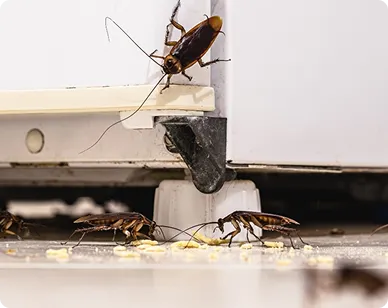
The American cockroach is larger, reddish-brown, and prefers damp, low-traffic areas like basements, crawl spaces, and floor drains. It's often the species behind an infestation that seems to be coming up from below rather than spreading across a countertop. Older Frederick basements with any degree of moisture are exactly the environment this species looks for.
The Oriental cockroach is dark, slow-moving, and also drawn to cool, damp spaces. It's less common indoors than the other two but shows up reliably in homes with persistent basement moisture or foundation issues.
Getting the species wrong changes the outcome. A treatment plan built for a German cockroach kitchen infestation won't touch an American cockroach population living in a crawl space, which is why identification comes before treatment, not after.
Signs You Actually Have a Roach Problem

A single live sighting is reason enough to act, but there are other signs worth watching for, especially in Frederick's older homes and downtown rowhomes where shared walls and plumbing chases let an infestation spread between units without anyone realizing it.
Look for small, dark droppings resembling coffee grounds or black pepper, oval egg casings, and shed skins left behind as roaches grow. A persistent musty, oily odor is another reliable indicator, and it tends to get stronger as an infestation grows rather than fading. Dark grease-like smears along baseboards or cabinet edges mark the paths roaches travel repeatedly. If you're hearing a light rustling or scurrying sound at night when the kitchen is otherwise quiet, that's consistent with roach activity rather than rodents.
Why This Is a Health Problem, Not Just a Nuisance
The instinct is to treat a roach problem as a cleanliness issue. It's actually a documented health risk, and one that doesn't go away just because the roaches you can see are gone.
Cockroach feces, saliva, eggs, and shed outer coverings contain substances that are allergenic to humans, particularly those with asthma or other respiratory conditions, and cockroaches also carry bacteria that can cause salmonella, staphylococcus, and streptococcus infections if deposited on food. This is according to the U.S. Environmental Protection Agency, and it's the reason a roach infestation matters well beyond the ick factor. The allergen particles are small enough to stay suspended in dust long after the roaches themselves are dealt with, which is exactly why sanitation has to be part of the solution, not an afterthought to it. US EPAUS EPA
How Professional Treatment Actually Works
Effective roach control starts with identifying the species and locating where the colony is actually living, not just where it's being seen. German cockroaches hide in tight cracks near heat and moisture, typically behind appliances and inside cabinet voids. American and Oriental cockroaches concentrate in basements, crawl spaces, and around foundation gaps and drains.
Treatment is matched to what's actually present. That means targeted application at harborage sites rather than a general spray across visible surfaces, followed by physical removal of egg cases, droppings, and shed skins so the allergen load in the home actually goes down instead of just sitting there. Entry points get sealed as part of the same visit, including foundation gaps where American and Oriental cockroaches are getting in. Our foundation and crawl space sealing service covers that scope when a basement-level infestation calls for it. A reinspection afterward confirms the population is actually gone rather than just knocked down temporarily.
A Protection Plan That Actually Prevents Reinfestation
Getting rid of the roaches you have is one job. Keeping a new colony from establishing is a different one, and it's the part a one-time spray never addresses. That means ongoing moisture control in basements and crawl spaces, sealed entry points that stay sealed, and sanitation practices that remove the food and water sources that drew roaches in to begin with. For homes with a history of recurring activity, a monitoring schedule catches a new population while it's still small enough to be a quick fix instead of a repeat infestation.
Fast Response Cockroach Control Throughout Frederick County
Nature Shield is based in Frederick and serves homeowners throughout Frederick County, including Middletown, Walkersville, Brunswick, Thurmont, Myersville, and the surrounding communities. We're a veteran-owned, fully licensed pest control and wildlife removal company, and cockroach infestations are one of the most common calls we handle during peak summer activity.
Schedule Your Free Cockroach Inspection in Frederick, MD
Call Nature Shield at (301) 970-9709 or request your inspection online. The inspection identifies the actual species and the actual source, so the treatment plan addresses the real problem instead of guessing at it.