
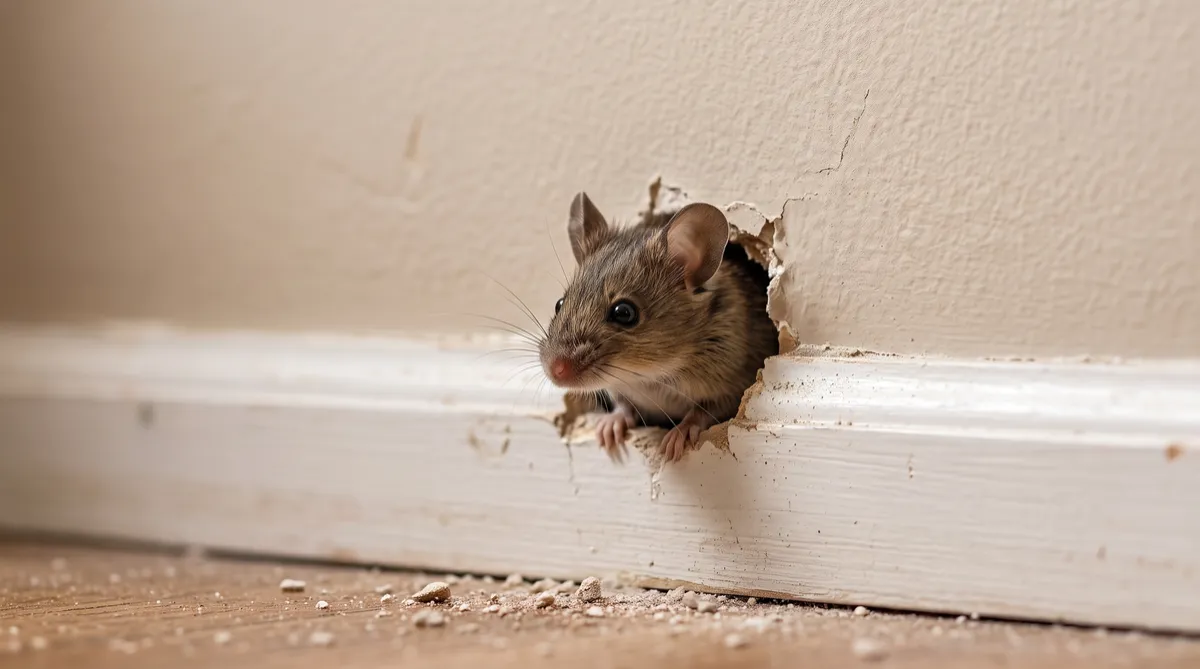
Sealed the Holes but Still Have Mice? 5 Reasons Mice Keep Coming Back
If mice keep coming back after you've sealed the holes, the seal almost certainly isn't the whole problem. Usually the patch was chewed through, other entry points were missed, or mice were already inside when the gaps were closed. Sometimes it isn't mice at all. Here's what typically goes wrong, and why a second round of patching rarely fixes it.
October is when this shows up most. Mice are pushing hard to get indoors before winter, and a patch that seemed fine in summer gets tested every night.
1. The patch was something mice can chew through
A mouse's front teeth never stop growing, so it gnaws constantly. Many common household fixes are softer than the wood and drywall mice already chew through every day.
What was used | Why it fails on its own |
Expanding foam | Soft enough for mice to chew straight through, often within days |
Caulk | Chewable, and can't bridge anything wider than a crack |
Steel wool | Rusts and breaks down in damp spots; mice can pull loose wool out |
Wood or plastic patches | Mice gnaw through both routinely |
Standard rubber door and garage seals | Easy to chew, and garages are a favorite way in |
When a foam patch fails, it often fails in a way that's hard to see: the mouse tunnels through the back of it, and the front still looks sealed. Professional exclusion uses materials rodents can't chew, chosen for each specific location, so the fix holds for years rather than weeks.
2. You sealed the hole you found, not the ones you didn't
Most homes with mice have more than one way in. The hole under the kitchen sink is the one people notice, but it's often just where mice come out, not where they get into the house.
The real entry points tend to be in places homeowners rarely look:
Along the sill plate, where the house frame sits on the foundation
Around AC lines, dryer vents and utility openings outside
At garage door corners and seals
Along the roofline, soffits and attic vents, which mice reach by climbing siding, downspouts or nearby branches
A mouse needs a gap about the size of a dime. Closing one gap just sends mice to the next one, which is why activity often stops for a week or two and then starts again.
3. The mice were already inside

If mice were living in your walls when the gaps were sealed, the seal didn't keep them out. It kept them in. Trapped mice keep breeding, keep foraging in your kitchen, and may chew new exits through drywall or around the patch itself. Any that die inside wall voids can leave odors that last for weeks.
This is why timing matters. Professional exclusion coordinates removal and sealing so mice aren't locked in with you, and confirms the house is clear before the job is closed out.
4. It might not be mice
Scratching in the walls and droppings in the pantry usually mean mice, but not always. Rats are stronger chewers, use larger openings and often burrow along foundations. Squirrels get into attics through the roofline. Each needs a different approach, and a fix designed for mice won't stop a rat.
Dropping size, the timing of the noise and the location of the activity all help tell them apart. Our guide to the signs of mice in your house covers the differences, but an on-site inspection is the only way to be sure.
5. Your house changed
Even a good seal doesn't last forever if conditions change around it. Maryland's freeze-thaw cycles open cracks in mortar and foundations. New cable, plumbing or HVAC work can leave fresh openings. Shrubs and branches grow back against the house and give mice a new path to the roof. A home that was tight last fall may not be this fall.
What a professional inspection finds that DIY misses
The difference isn't effort; it's method. A professional exclusion inspection works through the whole structure systematically, from the foundation to the roofline, including areas most homeowners can't safely reach. It identifies the species, maps every active and likely entry point, and tracks where mice are traveling inside so nothing gets sealed in.
At Nature Shield, every job starts with a free whole-home inspection. You get a written plan showing what we found and how we'll fix it, then we seal every entry point with rodent-proof materials, remove the mice already inside, and clean up what they left behind. Our foundation and crawl space sealing and roofline repair services handle the structural fixes, and exclusion work is backed by a one-year warranty.
What to do before your inspection
You don't need to keep patching. In fact, it helps not to. Leave your earlier repairs in place so we can see where mice have been chewing, and make a note of where and when you see or hear activity. Both help us find the real entry points faster.
If you're near Mount Airy, see our rodent exclusion in Mount Airy, MD page, or learn more about our mouse removal service.