Wasp and Hornet Nest Removal in Frederick, MD: Why DIY Fails and What Actually Works
Finding a wasp or hornet nest near your home triggers an immediate and understandable instinct to deal with it fast. That instinct is reasonable. What is not reasonable is acting on it without understanding what you are dealing with. Wasps and hornets are not nuisance pests in the way that ants or mice are. A disturbed colony responds in seconds, stings without limit, and can pursue a threat for a significant distance from the nest. The medical consequences of a mass stinging event are serious even for people with no known allergy. This article covers the species you are most likely to encounter in Frederick, why DIY removal fails in ways that consistently make the problem worse, and how Nature Shield handles nest removal safely and completely.
Wasp and Hornet Species Common in Frederick, MD
Knowing what species you are dealing with is the foundation of any effective removal approach. Different species nest in different locations, respond differently to disturbance, and require different treatment methods. The University of Maryland Extension's guide to social wasps is the most authoritative identification resource available for Maryland homeowners and is worth reviewing if you are trying to identify what you have seen.
Yellowjackets
Yellowjackets are the most aggressive common species in Maryland and the most frequent source of mass stinging incidents around Frederick homes. They are bold black and yellow, roughly half an inch long, and build nests in the ground, inside wall voids, and within structural cavities, not just the visible hanging paper nests most people associate with stinging insects.
Ground nests are particularly dangerous because they are discovered by accident. A homeowner mowing the lawn, a child running through the yard, or a dog following a scent trail can disturb a ground nest before they have any idea it is there. Yellowjacket colonies can reach up to 25,000 individuals over a season, and a disturbed ground nest produces a coordinated defense response within seconds. Late summer and early fall bring an additional aggression spike as colonies reach peak size and food sources become scarcer, making August and September the most dangerous months for accidental nest encounters in Frederick County.
Bald-Faced Hornets
Despite the name, the bald-faced hornet is not a true hornet. It is actually a type of native yellowjacket. Only the European hornet and bald-faced hornet occur in Maryland. Bald-faced hornets are black with distinctive white facial markings and are larger than standard yellowjackets. They build the large, enclosed gray paper nests commonly seen hanging from trees, eaves, and overhangs.
The queen continues creating workers into the summer until the nest has 100 to 400 individuals. Bald-faced hornets are highly defensive of the nest and will pursue threats aggressively. Their aerial nests look dramatic and are often noticed before the colony reaches full size, but the visible nest is only part of the picture. A nest under an eave or overhang that appears manageable in June is a much more serious situation by August.
European Hornets
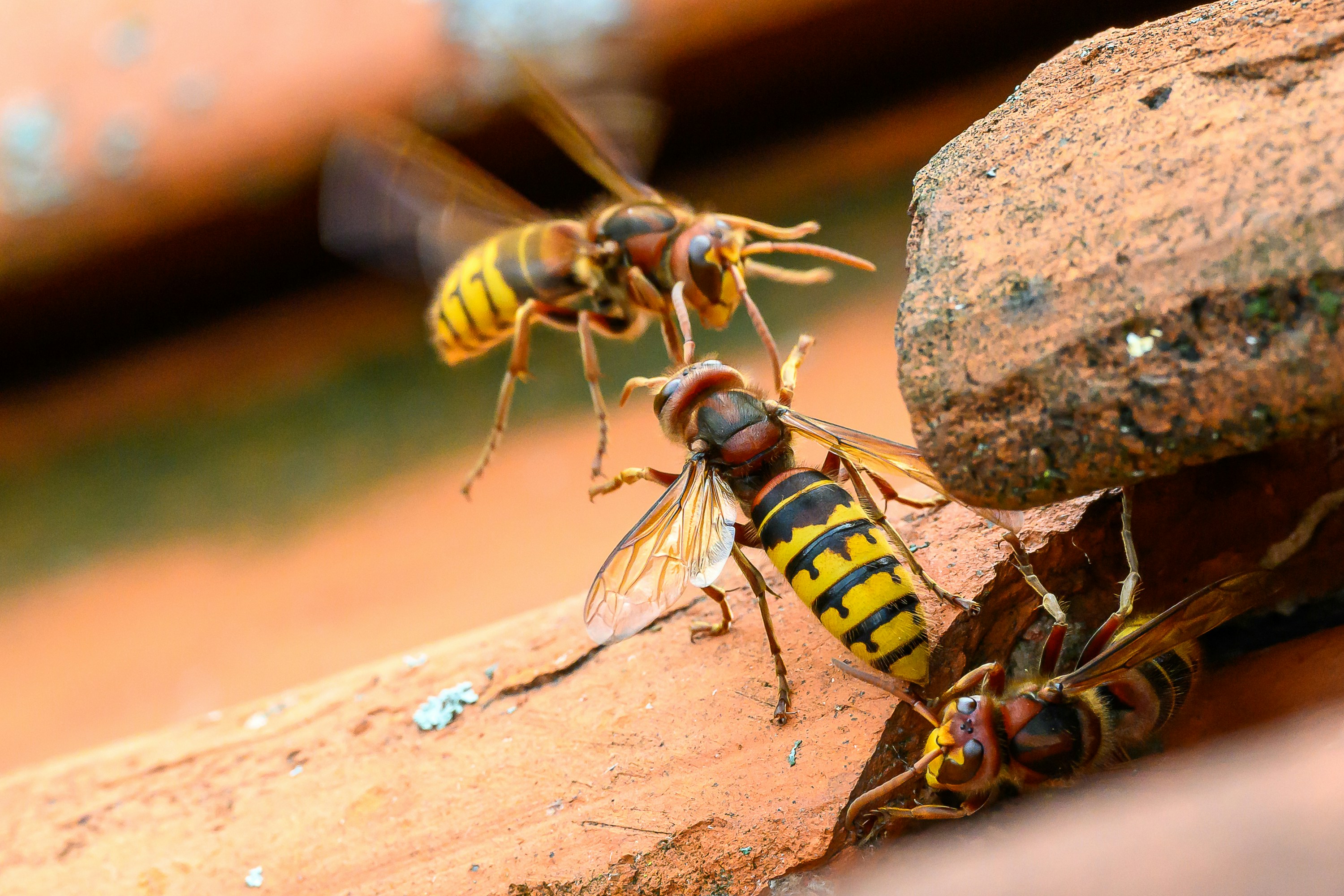
The European hornet is the only true hornet established in the United States. It is a non-native species but has lived in North America for over a hundred years. It is relatively large among social wasps, ranging from three-quarters to one and three-eighths inches long, with brick-hued reddish-brown coloring and golden yellow on the abdomen and face.
European hornets prefer to nest inside hollow trees, wall voids, and attic spaces, which makes them significantly harder to detect than species building visible aerial nests. Their nocturnal activity means a colony can become well established inside a structure before a homeowner notices any surface activity. European hornets are also capable of chewing through drywall and wood to expand nest space inside wall voids, which creates structural damage that compounds the longer the nest is left in place.
Paper Wasps
Several species of paper wasp occur in Maryland. They are medium-sized among social wasps and may look larger in flight due to long dangling legs. Body colors vary between species and typically include yellow, brick-hued reddish-brown, and near-black.
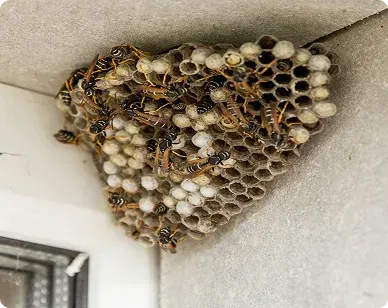
Paper wasps build small open-comb nests under eaves, on porch ceilings, behind shutters, and in door frames. They are less aggressive than yellowjackets or bald-faced hornets but will sting when a nest is disturbed, and nests built adjacent to doors, windows, or vents frequently result in wasps entering the living space. For detailed species identification beyond what is covered here, the University of Maryland Extension Bees and Wasps resource provides species-level guidance with photos.
Why Wasp and Hornet Stings Are a Medical Risk
The medical risk from wasp and hornet stings is not limited to people with known allergies, and it is not a minor inconvenience. It is a documented public health concern worth taking seriously before approaching any active nest.
Anaphylaxis is a severe life-threatening allergic reaction that impairs breathing, causes a sudden drop in blood pressure, and can send the body into shock. It can occur within minutes of a sting. Estimates show that potentially life-threatening allergic reactions to insect venom occur in 0.4 percent to 0.8 percent of children and 3 percent of adults.
What makes this particularly relevant for nest removal situations is that anaphylactic reactions can occur in people with no prior history of severe reactions. A person who has been stung before without serious consequences has no guarantee of the same outcome from the next sting. Hornet, wasp, and bee stings account for an average of 72 deaths per year in the United States.
Beyond anaphylaxis, stings near the face or throat carry elevated risk even without a systemic allergic reaction, and multiple simultaneous stings from a disturbed colony create venom loads that require emergency medical attention regardless of allergy status. Children and pets are particularly vulnerable because they are less able to recognize and retreat from a developing threat quickly enough to limit exposure.
The risk from a nest removal attempt is not limited to the person making the attempt. A disturbed colony will pursue any perceived threat in the vicinity of the nest, which means family members, neighbors, and pets in the yard at the time of disturbance are all at risk.
Why DIY Wasp and Hornet Removal Fails
This is the section that matters most for homeowners who are considering handling a nest themselves. DIY removal does not just fail to solve the problem. In most cases it actively makes the situation worse.
Incomplete Nest Removal
Consumer spray products work by contacting individual wasps at the nest entrance or on the nest surface. They do not penetrate deep into ground nests, wall void nests, or the interior of large aerial nests where the majority of the colony, the queen, and the brood cells are located. Surviving members rebuild or relocate, often deeper into the structure where the next treatment attempt becomes even more difficult. A partial kill agitates the colony without resolving it, producing a more aggressive and harder-to-reach problem than the original.
Wrong Product for the Species
A yellowjacket ground nest requires a treatment methodology that reaches deep into the tunnel system. A European hornet nest inside a wall void requires structural access before any product can reach the colony. An aerial bald-faced hornet nest requires a different approach entirely. Consumer products are not formulated or labeled to address all of these scenarios effectively, and using the wrong product in the wrong situation risks dispersing the colony into the living spaces of the home rather than eliminating it.
Never seal off a nest entrance inside a wall void with caulk or expanding foam. Doing so will force thousands of stressed wasps to chew through your drywall and flood inside your living space. This is one of the most common and most costly DIY mistakes Nature Shield encounters during service calls in Frederick County.
No Protection Against Swarm Response
Consumer protective gear, including the light netting and thin gloves available at hardware stores, is not adequate protection against a fully mobilized colony. A disturbed bald-faced hornet or yellowjacket colony produces a rapid, coordinated defensive response. The window between nest disturbance and full swarm is measured in seconds. Stings through lightweight clothing are common when a large colony responds, and the number of stings sustained in that window can create serious medical situations very quickly.
Timing and Reinfestation
Treatment applied during daylight hours when foragers are out of the nest is significantly less effective than treatment timed to when the full colony is present. Nests that are treated but not physically removed after the colony is eliminated become attractive sites for new colonies the following season. Structural entry points left unsealed after removal, particularly for European hornets and yellowjackets nesting in wall voids, guarantee reinfestation.
How Nature Shield Removes Wasp and Hornet Nests in Frederick, MD
Our wasp and hornet removal service addresses every stage of the problem: identification, treatment, physical removal, and structural sealing.
The process begins with a thorough inspection to identify the species, locate all active nests including ground nests and hidden colonies in wall voids and attic spaces, and assess any structural entry points that need to be addressed after treatment. Finding all nest locations before any treatment begins is what separates a complete removal from a partial one.
Treatment uses professional-grade products appropriate for the specific species and nest location, applied by licensed technicians with proper protective equipment. For European hornets and yellowjackets nesting inside structures, this includes gaining structural access to reach the colony rather than attempting surface-level treatment.
Physical nest removal is completed after treatment is confirmed effective. Abandoned nests left in place attract new colonies. Our vent covers and chimney caps service addresses overhead structural access points that give stinging insects entry into attic spaces and wall voids. Structural gaps at the foundation, soffit, and roofline are sealed to prevent reinfestation at the same locations.
Nature Shield is licensed by the Maryland Department of Agriculture for pest control services, which covers all stinging insect treatment. This licensing is the legal requirement for professional wasp and hornet removal in Maryland, and it is worth verifying with any company you consider for this work.
Preventing Wasps and Hornets Around Your Frederick Home
Prevention is the most cost-effective approach to stinging insects, and it does not require treating an active nest. These measures reduce the likelihood that wasps and hornets establish nests in high-risk locations around your property in the first place.
Seal gaps in soffits, eaves, and along the roofline before spring. European hornets and yellowjackets access wall voids and attic spaces through gaps that are often present in aging rooflines and deteriorating soffits. Cap chimneys and cover attic vents with properly screened covers to eliminate overhead entry points. Our custom animal-proof barriers provide permanent structural solutions for properties with recurring stinging insect pressure.
During peak season, keep outdoor food, pet food, and open beverages covered. Remove fallen fruit from trees promptly, as decaying fruit is a significant yellowjacket attractant. Inspect eaves, porch ceilings, and shutters regularly in May and June, before nests become well established. A small paper wasp nest with a handful of individuals in early May is a very different situation from the same nest in August.
Address ground nesting pressure by filling rodent burrows around your property. Yellowjackets commonly repurpose abandoned rodent tunnels for ground nests, and reducing available underground cavities near the home reduces the likelihood of a ground nest appearing in a high-traffic area. Our pest control services cover the rodent pressure that creates this secondary stinging insect risk.
Serving Frederick County and Surrounding Areas
Nature Shield serves all of Frederick County including Middletown, Walkersville, Brunswick, Thurmont, Myersville, and surrounding communities. We are a veteran-owned, licensed wildlife control and pest control company fully licensed by both the Maryland Department of Agriculture and the Maryland DNR Wildlife and Heritage Service. Stinging insect removal follows the same professional standards we bring to every service we provide.
For homeowners dealing with raccoons, squirrels, bats, or other wildlife alongside stinging insect pressure, our wildlife removal services cover the full range of nuisance wildlife situations throughout Frederick County and the surrounding region.
Schedule Your Wasp or Hornet Nest Inspection in Frederick, MD
Call Nature Shield at (301) 970-9709 or request your free inspection online. The inspection is free, the assessment is direct, and the work is done by licensed professionals with the equipment and training to handle it safely.
Nest size and colony population grow throughout the summer. A nest that is manageable in June is a significantly larger and more complex removal in September. Early removal costs less and carries less risk for everyone involved.